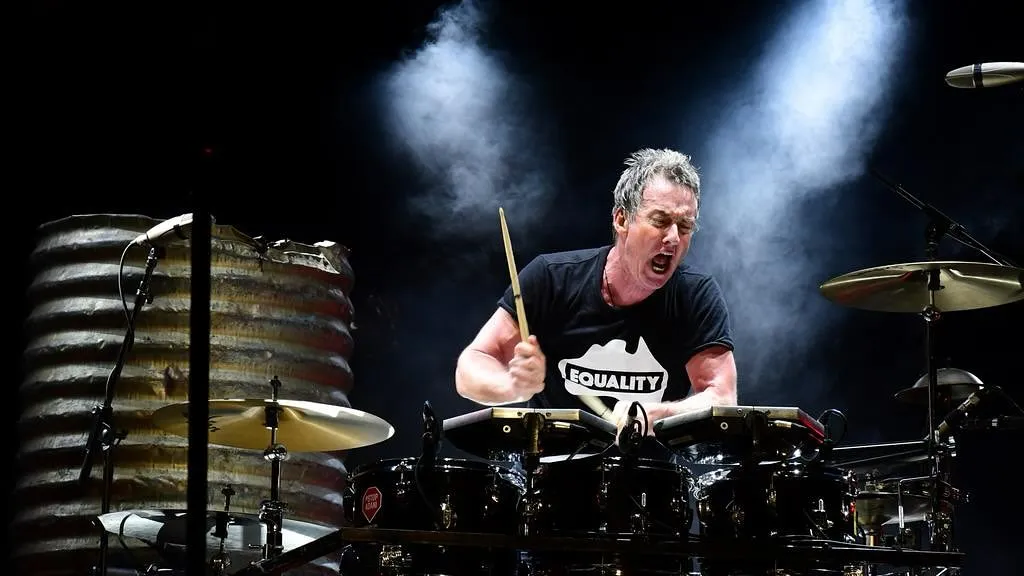
On 20 January this year, I was deeply saddened to hear of Rob Hirst’s passing. To be honest, I had no idea he was ill, so it came as somewhat of a shock, too…
For those that aren’t familiar with his work, Rob was best known as the drummer and co-founder of Midnight Oil. But that “definition” barely scratches the surface.
I think most people that know of his work would agree that he was the engine room of one of the most important bands in my country of origin… and his impact on me, personally, has been profound.
I am surprised I’ve not seen more written by Australian musicians and cultural commentators about his life and his work. Maybe the algorithm has just been hiding them from me? If you’ve spotted any good articles, please share them in the comments.
In any case, I felt moved to pen this (belated) “in memorium” to mark his passing and share just how much I appreciate and admire him as a person and musician.
When the Generals Talk
My first real awareness of Midnight Oil came via an unusual path: it was “When the Generals Talk,” from the 1984 album Red Sails in the Sunset. The song is a stylistic outlier for the band—it most definitely doesn’t sound like what most folx would associate with Midnight Oil. But the sound of that song really caught my young attention. I loved that song, and waited patiently for it to come onto the radio. I think I probably recorded it to cassette at some point…
It didn’t register to me at the time that Rob Hirst sang lead on that track, which is itself unusual for the Oils (sorta… more on that later). As a 9 year old white kid growing up in the ‘burbs, I didn’t have the foggiest idea about the political content nor context for the song. I didn’t know about nuclear anxiety or Cold War brinkmanship. It was just a single on the airwaves that I thought was brilliant.
As I got a bit older, a high-school friend put me onto the full Red Sails in the Sunset album. It was then I discovered the context in which the song came to be, and with a much deeper appreciated, I had that album on high rotation for a long time. And slowly, the lyrics started to land, even if the full political awakening was to come later. The seed was planted, by a Rob Hirst song.
The Peak
For me, the run of albums from 10, 9, 8, 7, 6, 5, 4, 3, 2, 1, through Red Sails in the Sunset, Diesel and Dust, and Blue Sky Mining represents the absolute peak of Midnight Oil’s output. While there are many songwriters within the band, Rob was clearly central to the musical identity across all of the songs and albums he was part of creating.
When Diesel and Dust broke, it was absolutely massive. But Blue Sky Mining was the one I connected with most deeply. The running theme is that it wasn’t until years later that I fully appreciated both the political weight of the lyrics and the sheer intricacy of the musicianship. There’s a sophistication in those records that their “pub rock” reputation perhaps quietly dismisses in the eyes of many.
I think about my favourite guitar-oriented bands—the likes of Death Cab for Cutie, Bloc Party, and Interpol—with their dual guitar interplay, the interlocking parts, the way two guitars can create something greater than either one alone. I didn’t recognise these same traits in Midnight Oil until one of my indie band-mates pointed it out to me one day, when we were watching a replay of their renowned JJ concert on Goat Island:
These intricacies are absolutely present in Midnight Oil’s music, between Jim Moginie and Martin Rotsey. (I had the privilege of hearing this in stunning clarity and power at the second Oil’s live show… more on that later.)
But perhaps not so obvious is how Rob’s drumming melds into that so seamlessly. He wasn’t just keeping time—what is considered the “traditional” role of the drummer—he was absolutely part of the whole conversation.
Midnight Oil started as a “surf music” band on Sydney’s northern beaches and emerging in the same late‑1970s Australian “pub rock” circuit as bands like Cold Chisel, The Angels and Men at Work. But like a handful of bands from that era, the musical sophistication of their arrangements ran far deeper than their popular-music reputation would suggest. Not just the guitar interplay, but in the vocal harmonisation and the dynamics.
Rob Hirst, as both songwriter and drummer, was a huge part of that depth, in my opinion.
The live powerhouse
I had the privilege of witnessing Midnight Oil perform live, twice.
The first time was at the Woodford Folk Festival in 1996—a beautifully unlikely setting for the Oils. Powderfinger, then an up-and-coming band, were also on the bill and had supported the Oils at that show.
One of the most vivid memories I carry is seeing the members of Powderfinger sitting to the side of the stage. They were watching as intently as we were, completely absorbed, taking photos, singing along. In awe.
Peter Garrett’s performance was characteristically intense, but the whole band was just… I don’t know how to articulate it… energy personified?! Whereas some drummers can disappear in the shadows at the back of the stage, Rob Hirst may as well have been front and centre with Garrett for the whole show. His energy, his presence… you just couldn’t miss it. It was palpable.
The second time was years later, on the tour for Resist in 2022, their final album with Rob (perhaps altogether… I can’t see the band continuing without Rob behind the kit, but who knows 🤷🏼♀️).
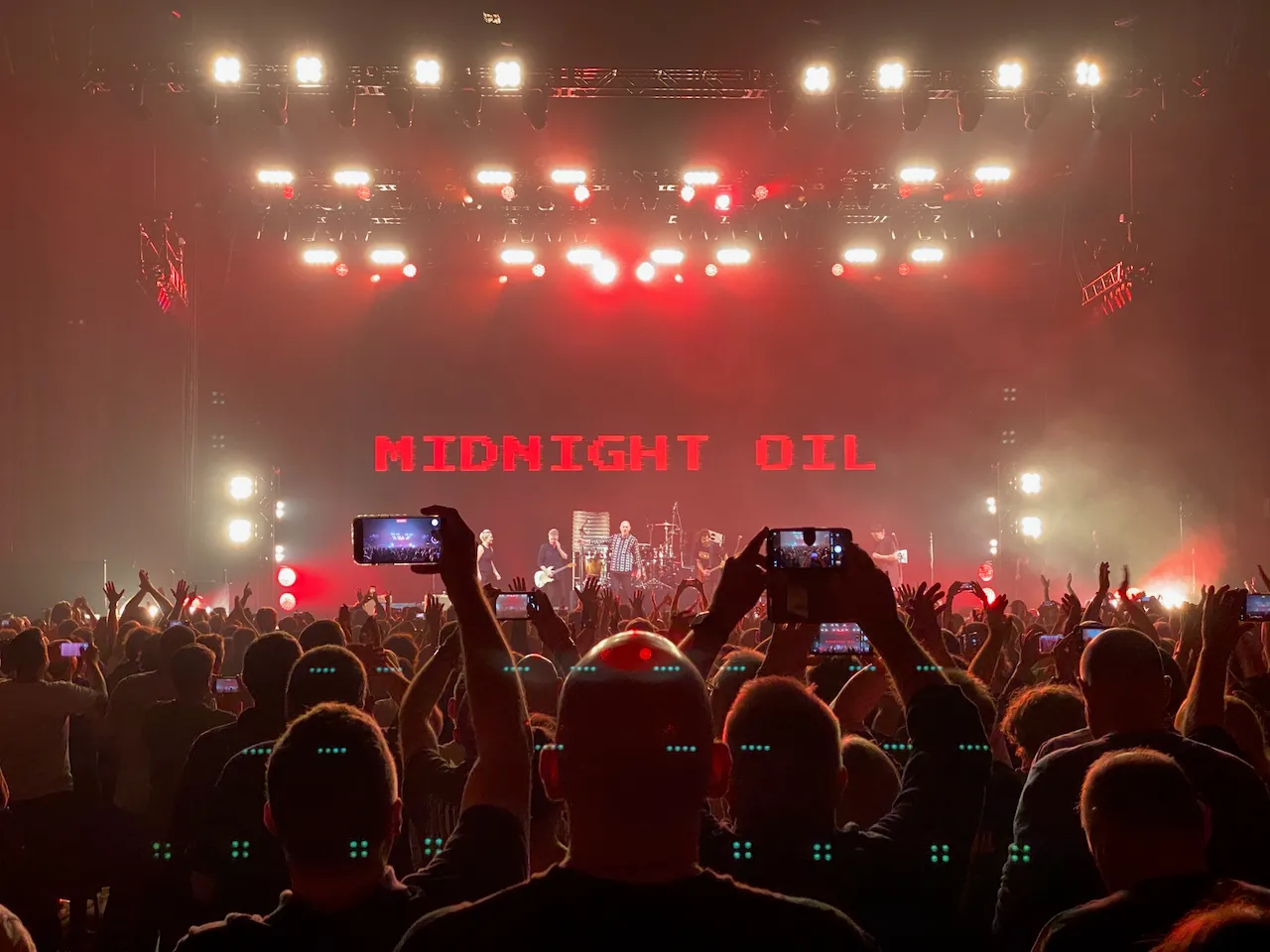
I was lucky enough to be seated dead centre, right in front of the mixing desk. The sound was impeccable. And Rob was as strong and present as ever—by then 67 years young. Absolutely sensational!
And as someone just entering their 50s, words can’t express just how inspiring it was to hear them with the same intensity and energy so many years into their journey.
More than a drummer
I want to loop back to Rob’s vocal contribution to Midnight Oil.
Even on songs where he isn’t credited or considered as “lead” singer, his harmony vocal often functions as a dual lead. Rob’s vocals aren’t buried underneath or in the background… they’re right there up-front in the mix, lifting the song, shaping the hook. In my opinion, some of the most memorable melodic moments in Midnight Oil’s catalogue come from his voice. Testament to this fact is that they’re the lines I hear in my head—and sing along to!—when the songs come on.
And of course, he was a songwriter for the band, contributing both lyrics and music, to so many of the songs that define the band. Jim Moginie described him as the “engine room, onstage and off. Rob was brash, funny and super intelligent”. (Which, frankly, is no surprise to me.)
The combination of political intent woven into rock songwriting is something I carry directly into my own work. If I had to name the artists most responsible for teaching me that a song should say something important, the two that immediately come to mind—without hesitation—are Midnight Oil and Ani DiFranco.
They’re a central part of my musical lineage. That’s the tradition I try to honour, in my own work.
But a GREAT drummer, at that
I have to say, though, that you simply cannot overstate the role that his drumming and instrumentation in shaping so much of what we experience as Midnight Oil’s sound.
And that is, somehow, a representation of the sound of Australia, itself. You can somehow hear the landscape I grew up in, the Australian way of life, the countryside, the politics, the people, the pubs, the long stretches of road, in their music. And, to me, I attribute much of this sense to Rob’s playing, his sound, the kit and his choice of instruments, is such an integral and key part of how that atmosphere is imbued in their music.
Ask Midnight Oil fans what drummer Rob Hirst will be remembered for, and the most likely answer will be his drum solo on Power and the Passion, one of the band’s big early hits. It’s an explosive minute of almost literal madness – Hirst was on the verge of a breakdown when the track was recorded in 1982, for their breakthrough album 10, 9, 8, 7, 6, 5, 4, 3, 2, 1.
Drum solos had, by that time, become a symbol of rock excess. But this wasn’t just another vulgar display of virtuosity. It was more musical than most guitar solos, enhancing a song already full of moving parts. Live, much of it was played on a corrugated iron water tank Hirst retrieved from the desert on the Oils’ Blackfella/Whitefella tour in 1986.
The JJ performance provides a classic, early incarnation of the solo:
And a more recent incarnation, with the water tank:
The Exxon moment
For me, the moment that crystallised everything Midnight Oil stood for, was their protest show on 30 May 1990, where they pulled up on a flatbed truck outside the Exxon headquarters on Sixth Avenue in New York City, unfurled a banner, and blasted through a lunchtime set in protest of the Exxon Valdez oil spill.
They played River Runs Red, Instant Karma, and a handful of other corkers (as we say here in Australia). They did it in front of bewildered office workers and thousands of passersby, and it made front-page news around the world—bringing attention to the devastating effects of the spill, and the corporate negligence behind it.
That’s when I truly understood the energy of this band. The ferocity. The sharpness. The willingness to take a position and hold it, loudly, defiantly, justifiably angrily, in front of the people who needed to hear it most.
To my mind, their intensity is on par with that of Rage Against the Machine. In a “similar but different” kind way. (And you can fight me in comments, if you wanna debate it… 😉)
Moving culture
Midnight Oil have been an intensely influential force in Australia’s cultural and political landscape. They hold immense respect within the Indigenous community. They had average Australians singing about Aboriginal land rights when many didn’t even fully grasp what the words meant (perhaps still don’t). The depth of their politics infiltrated the national psyche on the back of songs that were undeniably, great music.
Songs like Power and the Passion. Dreamworld. The Dead Heart. Beds Are Burning. And So. Many. More… Each powerful political statements, wrapped in crackin’ rock songs. Protest music that you could—and did—shout along to in a pub. It’s little wonder that Garrett literally took up a place in parliament in what I suppose you could call a mid-career sojourn.
I’ve seen a lot written about the band’s political stances themselves, but not so much on the impact they’ve had on the actual attitudes, “hearts and minds” of the Australian people. But I can say, from lived experience, it’s been profound. Certainly, it’s awoken this lil’ black duck tremendously.
How about you? Have the Oils had an influence on your worldview? Have you witnessed an affect on those around you?
His spirit will live on in so many people, musicians and lay-folk alike. I, for one, will continue to do my best to honour his spirit and legacy in my own work.
What an amazing legacy…
Vale, Rob Hirst. 1955–2026.